{{{ title }}}
{{# subtitle }}{{{ subtitle }}}
{{/ subtitle }}
{{{ markup }}}
{{/ Thumbnail }}
{{# Mood }}
{{{ markup }}}
{{/ Mood }}
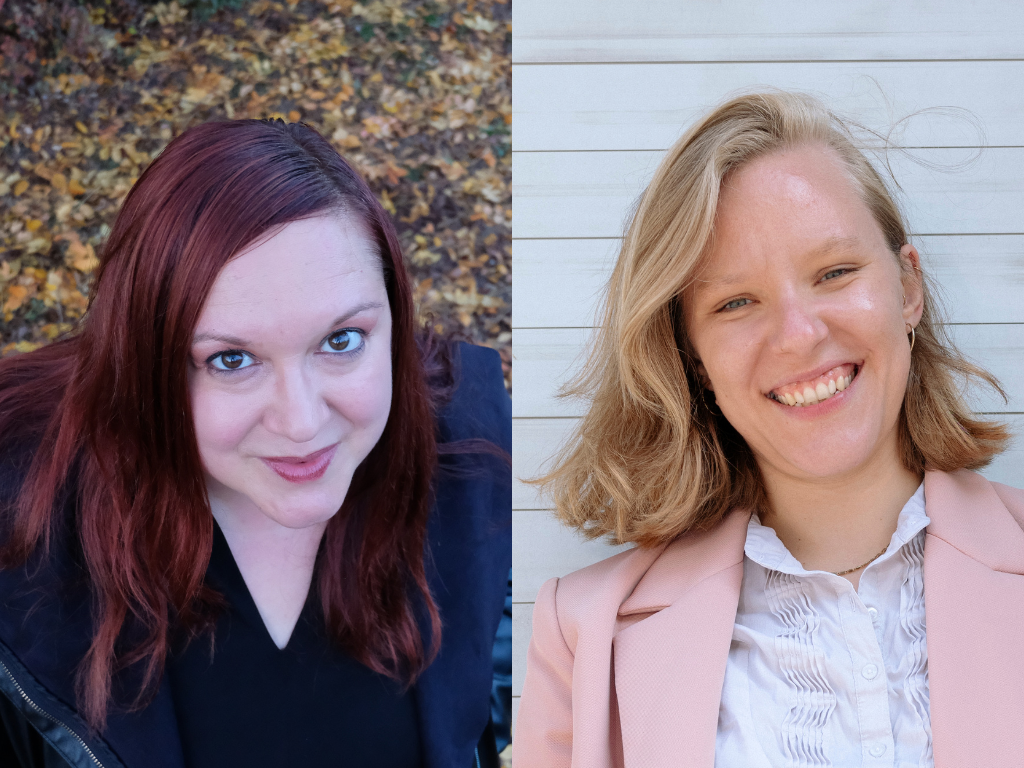
»Doomscrolling for future! So good«–Margareta Ferek-Petriс and Raphaela Edelbauer in conversation with Alexey Munipov
»Doomscrolling for future! So good« is a chamber music theatre piece in which composer Margareta Ferek-Petrić and librettist, Austrian writer Raphaela Edelbauer, take aim at social media as a contributing factor in contemporary crises. Edelbauer’s exploration of media oversaturation, overload, and fragmentation into aphoristic minutiae provides an ideal framework for Ferek-Petrić, who has long envisioned a vocal work for the Neue Vocalsolisten.
Could you introduce it to the piece? How does it work, and what should we expect?
Margareta Ferek-Petric:
The idea was to represent–in a metaphorical way–the online world of social media. For me it was also a process of understanding myself: how I want to structure it, how I want to do it. I’ve known Raphaela for quite some time now, and I really love and respect her work.
At first I only had a very rough idea. Raphaela wrote three versions of the text, and at that point I started to write notes–the musical part of the piece, not just sketches but actual ideas. And I realized that I had no idea how to approach it.
Then I understood how important it was that Raphaela gave me freedom with her text. I knew the musical dramaturgy had to be quick, very much in motion. It had to flow fast, because it’s about scrolling. I wanted the audience–and myself while listening–to perceive it as a musical version of scrolling.
It was quite instinctive. After all the sketches and structures, I realized they weren’t enough. I put them aside and actually started to scroll while composing, just to feel what it does to my head, my mood, my intellect. In the end, I approached it very instinctively.
The piece is supposed to be funny. Humor is tricky, so I constantly question myself: is it really funny? Because it’s not easy to achieve humor. You can laugh at the gestures and actions, but at some point it gets stuck in your body. You start asking yourself: is it really funny, when it describes the extremes you see on social media?
The title Doomscrolling for Future is meant ironically. So much of our lives happens on social media, and there are serious issues, especially for young people. I didn’t have this when I was coming of age. In a way, we are doomed by scrolling–it’s an ironic celebration. You hear this phrase so often: »so good.« But it’s not really good.
How is the text structured? Is it built from different layers or sources?
Raphaela Edelbauer:
Yes, exactly. In Austria we have a shockingly high number of femicides–killings of women by men. We also talked a lot about the incel phenomenon, which has become more prominent in recent years.
I wanted to show the arbitrary nature of a social media feed. It often feels incredibly random: advertisements, then a short video clip, then a challenge all your friends are doing. But underneath these layers of naivety, there are extremely violent tendencies hiding.
The original text was much more voluminous than Margareta could work with. For a writer it’s very humbling to write in a way that allows a composer to do something with it. We work with very complex syntactical structures, especially in my literature. So we had to reduce, reduce, reduce, until we reached a core we could both live and work with.
That leads directly to my next question. When you write a text for a musical performance, what changes? How different is it from writing a book or a story?
Raphaela Edelbauer:
To put it simply: sentences in literature are usually far too long. You can’t just take a paragraph from one of my novels and set it to music. You need to chop it into volatile, quick pieces so that the musical pace can work with it.
Margareta asked me several times to really boil it down to the essence and told me: »Can I do whatever I want with it?« If I had been stubborn with the text, it would have been impossible.
Margareta Ferek-Petric:
Yes, it would have been impossible. This piece had to develop in my head. I’d never done something like this before–it’s a kind of concert music theatre, and I also use objects. With six wonderful singers who can basically do anything, this amount of freedom is also scary. You need time to understand what you actually want.
What kind of objects do you use? Are they mostly musical tools?
Margareta Ferek-Petric:
There was a very nice moment when I went to Stuttgart. There’s a cellar with lots of instruments and objects, and two singers went down there with me. We went through all the boxes–it felt like searching through the history of pieces they had already performed.
Some objects are serious instruments, like percussion. Others are almost silly: children’s percussion or small objects. I was confronted with the need to reduce information and sonic possibilities.
Eventually I made a plan. I assigned several objects to each singer and placed different scenes in different positions on stage. In each scene, everyone has something different in their hands while singing. There’s a timpani in one corner, and in another you have small things: squeaky animals, kalimbas, drumsticks–little objects you can easily move with while performing.
There were many practical challenges. Everything had to be playable while performing a vocal piece.
The theatrical aspect is very important, but it also works as a concert piece. You don’t need special lighting or costumes. The singers can simply stand there, change positions, perform gestures.
I wouldn’t dare to write something like this for an inexperienced ensemble. The piece is built around characters embedded in the voices.
The main feature of Doomscrolling is, of course, scrolling. How do you show scrolling in music? What’s the musical equivalent of that movement?
Margareta Ferek-Petric:
I asked myself that all the time. I decided not to limit myself to one gesture. It was important to observe how you actually behave while scrolling. It’s fast, but sometimes you stop. Sometimes you get distracted. Sometimes you change location–from the toilet to the kitchen–while scrolling.
All of that is part of the piece. Things happen very quickly. It’s active, rhythmic. The six singers sometimes function as one organism, and sometimes that form breaks apart into individuals. It’s a constant mixture of actions that can shock you, make you laugh, bore you, annoy you.
There’s no real calm moment. No resting place.
Did you treat different content layers–news, personal posts, violent material–differently in musical terms?
Margareta Ferek-Petric:
I made a clear plan with three layers, but it limited me too much. So I went with the flow. I didn’t assign specific gestures or sounds to specific types of content. News can sound completely different in different sections.
This makes sense, because social media always gives you the same things in different forms. That’s how I treated the layers of the text as well.
Do you expect the audience to use their phones during the performance?
Margareta Ferek-Petric:
Actually, I want the opposite. I want them to forget their phones and scroll with their minds through the piece. The irony is that I expect the audience to focus deeply for half an hour–the exact opposite of what social media does to our attention span.
I didn’t want an interactive phone piece. That’s been done many times.
This piece is about current technology and media habits. Raphaela, your books often deal with AI, memory, consciousness. Technology changes fast. Do you worry that the piece might feel obsolete soon?
Raphaela Edelbauer:
The technology isn’t used here as a compositional tool. It’s the topic, not the method.
Margareta Ferek-Petric:
There’s no electronics in the musical approach. I wanted to reduce everything to something naked: six singers, objects, and space.
Could it become obsolete? Maybe. I don’t worry about it. I do what feels right now. I try to challenge myself with every piece.
Also, I want to do something I haven’t done before. I was an artistic director of a festival myself, and when you search for pieces you realize how many people are doing very similar things. In the end, it’s all about how strong the message is, and how performers communicate it to the audience.
Raphaela Edelbauer:
I think music is different in that regard from literature. If I create a novel, it can age fast. But most contemporary music pieces are played and performed once or a couple of times and then not really taken on again after a decade. That’s probably a weakness of the music business as it is. But it’s also a strength, I think. You can have a testimony of your time and be very specific, and say: this is how our experience is. You don’t always have to think, oh my God, what happens with the piece in twenty years, as literature always has to do.
Margareta Ferek-Petric:
I’ve never had this feeling that I worry about what happens after I die. If my music isn’t played, I’m dead–I don’t care. Of course, I want to leave knowing that my music lives on stages. As a composer, you love it when pieces are performed more often, or when they enter some kind of repertoire, because they get better. That’s a fact.
The first performance is always very tricky. I’ve been in situations where chamber music or smaller line-ups can be played more often. But it’s the time invested in working on a piece–from the performers’ side–that actually creates the piece, making it better and, in a way, new again.
This is always the big issue with a new work: that it doesn’t become obsolete in the sense of being performed once and then forgotten, never finding a place in future programmes. But that’s just me. I think the freedom of being a composer–of being an artist–lies in doing what feels right, in challenging yourself with every new project, in searching for new ways of expressing yourself or reflecting your world.
Not everybody wants that. You do what you want, and then things unfold as they do. I don’t worry about whether a piece becomes obsolete or loses its meaning. I don’t think it will, at least for a while. Social media isn’t going away anytime soon.
I’ve just been discussing an NFT piece written five years ago, when NFTs were the hottest topic. Today, you’d have to explain what an NFT even is–it has already faded from collective memory. Now everyone is talking about artificial intelligence–and there are countless pieces being made around these technologies. I keep wondering what it will be in five years’ time.
Margareta Ferek-Petrić:
Things are changing so quickly that I honestly have no idea.
Raphaela Edelbauer:
I believe longevity is the next NFT of our time. Living longer, prolonging one’s own existence. In the context of collapsing ecosystems and threatened life systems, this is going to feel extremely urgent in the coming years.
And this connects to what I said earlier about contemporary pieces. They function as time capsules. They preserve something that is otherwise fleeting. If you listen to compositions created with the newest technologies a hundred years ago, there’s often something deeply charming about them. They aren’t obsolete in a simple sense.
So I think of this less as obsolescence than as the fragility of time.
Margareta Ferek-Petrić:
It also depends on which subjects the future will still find meaningful.
Raphaela Edelbauer:
But scrolling isn’t going to disappear. That much I’m certain of. It’s a very universal phenomenon.
Margareta Ferek-Petrić:
Exactly. The manifestations of scrolling–however you define them–are deeply embedded in contemporary society. I think it’s important for art to engage with that. Everyone approaches these subjects differently, but scrolling is something we take for granted. We do it without thinking–and that, in itself, is worth examining.
Do you think doomscrolling is something entirely new, or just an old human habit with a new interface?
Raphaela Edelbauer:
I think it is new. When we talk about scrolling, I also ask myself what its equivalents might be elsewhere. Dating apps, for example–Tinder and its endless swiping–lead to shallow encounters. This could be seen as a manifestation of the same impulse.
But still, I think it’s genuinely new in one crucial sense: very large, very powerful companies are now creating algorithms that make us truly addicted. They hack our neurological makeup in ways we can’t easily escape. That’s fundamentally different from the age-old narrative mechanisms I work with as a writer–where you try to capture someone’s attention, but through connection.
Here, the diabolical aspect is that everything appears arbitrary, while the sole purpose behind it is to sell–to sell, sell, sell. It doesn’t matter whether you see a video of an assassination or extreme cruelty–the next thing is an advertisement for a hair straightener, followed by a cake recipe that will make you unhealthy. Your attention is chopped into ever smaller pieces. That, to me, is truly new, and it requires the technology we have now.
Margareta Ferek-Petrić:
I was asking myself the same question while writing the piece. I remembered reading about similar things before social media–magazines, newspapers–but the form was completely different. It wasn’t as aggressive, not as saturated with rapid information.
I can’t find a real equivalent to the experience of scrolling. I read a lot when I was younger, and I still read–mostly online–but this sheer amount of information attacking my brain feels unprecedented. When I think about it honestly, I only encounter that intensity on social media.
Raphaela Edelbauer:
And there’s one more difference I want to point out. Scrolling is curated for you. It’s tailored to your needs, your fears, your social bubble.
There was an article in The Guardian recently showing how social media feeds actively curate fear for pregnant women and new parents. You’ll see something like: »Cupboard fell over, killed a baby.« Then the next post is about childhood cancer or leukemia and how to recognize it. Of course you click–all of them. It’s shameless.
This would never have happened in a magazine–not even in Bravo, the German youth magazine that featured nude teenagers for other teenagers to flip through. That was shameless in a different way.
Now fear itself has become the currency. The most basic human affects are monetized. That’s deeply disturbing.
You’ve described the piece as humorous–perhaps even satirical. When the crises we’re dealing with are very real, what can satire do in art?
Margareta Ferek-Petrić:
I’m a big fan of satire. In everyday life, I tend to react satirically–probably because of my upbringing. I was born in the 1980s, in the post-communist context of Yugoslavia, in Croatia. Humor, satire, irony–that’s my reflex. The crazier a situation becomes, the stronger my need for it.
I think satire is one of the most important human expressions. Humor, irony–they’re ways of understanding the world. I enjoy satire in many forms: stand-up comedy, the satirical press. I even supported a satirical publication in Austria when it was taken to court by a right-wing politician.
Humor can be seen as a coping mechanism–especially in times of crisis–but for me it goes deeper than that. It shows an intellectual connection with oneself and with society. I’m deeply afraid of a society in which satire or humor are no longer desired, or no longer exist.
Raphaela, did you also think of the text as satirical?
Raphaela Edelbauer:
Yes, absolutely. I’m not sure how much humor can actually achieve politically, but it’s striking that many of the most powerful and destructive figures of our time–Putin, Trump, Orbán–seem to have no sense of humor at all. They take themselves with deadly seriousness, without noticing the involuntary satire they embody.
For me, satire is clearly a coping mechanism–a form of survival. And of course, it leads to an age-old question: what can art really do in the face of political oppression, especially when that oppression is becoming increasingly hostile toward the kind of art we make our living with?
I don’t have a satisfying answer to that.
Margareta Ferek-Petrić:
Neither do I. Politically speaking, humor can’t achieve enough. But I still believe it’s an expression of a deep understanding of life.
Raphaela Edelbauer:
A sense of life.
Margareta Ferek-Petrić:
Yes–something like that. And that’s what connects people. That’s what humor can bring to a situation, or to an artwork.
| {{{ content }}} |
|---|
| {{{ content }}} |
| {{{ content }}} |
| {{{ strings.konzerte }}} | {{{ strings.unterstuetzer }}} | {{{ strings.regulaer }}} | {{{ strings.ermaessigt }}} |
|---|---|---|---|
| 35€ | 25€ | 14€ | |
| 28€ | 18€ | 10€ |
| {{{ strings.festivalpass }}} {{{ strings.beinhaltet_alle_konzerte_ausser }}} |
{{{ strings.unterstuetzer }}} | {{{ strings.regulaer }}} | {{{ strings.ermaessigt }}}* |
|---|---|---|---|
| 298€ | 208€ | 110€* |